|
The druid
said: “What
you lean on, owns you.”
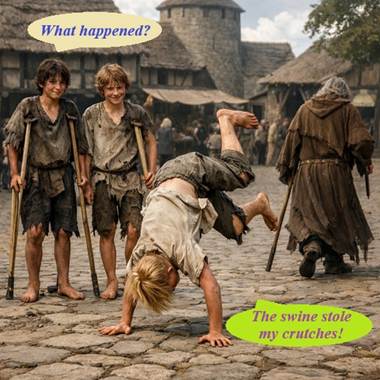
1. Surface Composition The scene
is deceptively simple: ·
Two disabled boys (on crutches) stand upright,
stable but dependent. ·
A third boy—previously disabled—is now in
motion, mid-somersault. ·
The speech bubble reveals the trigger: “The
swine stole my crutches!” ·
In the background, a ragged druid walks away,
indifferent, already gone. This is
not a sentimental scene. It is engineered. 2. The Functional Inversion At first
glance, the theft appears as harm (loss of support). ·
Crutches = stabilised incapacity ·
Theft = forced destabilisation ·
Somersault = recovered native function The key
move: The
removal of artificial support reactivates latent capacity. The boy
does not learn to move. 3. The Druid’s Role (System Intervention, Not
Compassion) The druid
does not help, teach, or comfort. He: ·
does not explain ·
does not stay ·
acts en passant ·
does not wait for gratitude or anger He removes
a constraint (preferably outside consciousness). The druid
serves as diagnostic systems engineer, not a moral agent. His
function: ·
Identify false stabilisers ·
Disrupt them ·
Allow the system to reconfigure He t5riggers
capacity restoration, not comfort. 4. The Core Mechanism: Dependency as Frozen Error The
crutches represent more than injury—they represent: ·
Entrenched adaptation ·
Learned limitation ·
Identity fixation The
druid’s act exposes a brutal principle: Support
systems tend to become self-reinforcing constraints. The
longer they persist: ·
the more they define identity ·
the less likely spontaneous recovery and
adaptation becomes Thus: 5. The Somersault (Proof of Native Capability) The
acrobatics are not symbolic flourish—they are evidence. ·
Not just walking → dynamic movement ·
Not recovery → overcompensation into
capability This
implies: The
organism was never fundamentally broken—only procedurally constrained. 6. The Two Boys (Observers = Potential Systems) They
still hold their crutches. They
represent: ·
Undisturbed systems ·
Watching the disruption of another Critical
tension: ·
They see the result ·
But still cling to support This is
where most systems stall: Observation
does not equal iteration. 7. The Druid Minim The image
encodes a hard operational law: Capacity
is restored not by assistance, but by the removal of unnecessary structure. Or, in
druid form: “What you lean on, owns you.” 8. Final Critique This is
not a moral image. It is a procedural diagram disguised as narrative. Strength: ·
Ruthlessly clear causal chain ·
No metaphysical padding ·
Demonstrates function, not belief Brutality: ·
No concern for failure cases (what if the boy
couldn’t move?) ·
Assumes latent capacity always exists ·
Ignores transitional suffering But
within the druid’s Procedure
Monism, that is consistent: The
system either reconfigures successfully—or it doesn’t persist. 9. The
Druid’s Function The druid
does not heal. |