|
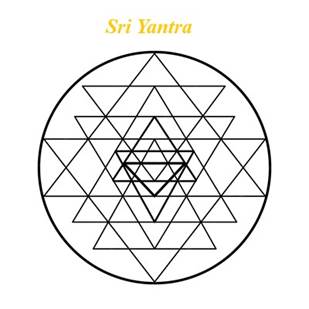
The Śrī Yantra as
Vacuous Placeholder A non-metaphysical,
technical essay on semiotics, attention-engineering, and escape protocols
from saṃsāric coupling By the druid Finn Abstract We
reframe the Śrī Yantra away from
metaphysical cosmogram and toward a designed
attentional instrument. Its defining feature—especially in the two
attested variants (with bindu vs without bindu)—is a deliberately under-specified centre
that functions as a vacuous placeholder. “Vacuous” here does not mean
useless; it means semantically indeterminate in a way that is functionally
productive. The placeholder’s role is to hold the observer in place
by entraining attention (i.e.
by entertainment), then to provide two non-metaphysical escape routes
from saṃsāric (i.e. this worldly) engagement: (A) release by
perfect objectification (completion/perfection), and (B) release by going
on-standby (disengaged being). This essay formalises those conclusions,
critiques category-errors that demand “more” from the yantra than its domain
allows and clarifies how the yantra trains naturally occurring momentary
escape states into controllable, longer-duration capacities.
1. Scope discipline: what this essay does and does not
claim Metaphysics
are explicitly rules out: “There
are no metaphysical claims made here.” So the analysis is kept in one
class of enquiry: ·
Class B (escape/control): How to exit
saṃsāric coupling
once already inside it. And we
exclude two other classes: ·
Class A (generation): How saṃsāra is
generated. ·
Class C (governance/ethics):
Normative regulation, moral systems, social control. This is
not a rhetorical move; it is a technical hygiene rule: a device can be
evaluated by its specified function without demanding it also solve
adjacent problems. The yantra is a machine for escape, not a
universal explanation engine. 2. The key empirical pivot was: two Śrī
Yantras, two centres The
decisive observation: “The SRI YANTRA comes in 2 versions, i.e. with a Bindu
or without a Bindu, hence the centre remains void.” That
single point reorganises the analysis. If the same canonical diagram can be
practiced with a marked centre or with an empty centre, then
the centre is not primarily a “referent” (a thing it means), but a functional
slot (a thing it does). This is
the first mark of a placeholder: ·
A placeholder is not defined by content; it is
defined by position in a system. ·
What matters is what the centre affords in
processing, not what it “is”. So the centre becomes an
engineered attractor for attention, either: ·
Bindu-centre: minimal positive content
(“point”) ·
Void-centre: formally contentless (“no
point”) Either way,
the centre is not a determinate object like a chair or a tree. It is a processing
handle. 3. “Vacuous placeholder” precisely: semantic
under-specification with functional potency Earlier I
characterised vacuity as: ·
occupying an integrative position, ·
without determinate content, ·
remaining indefinitely re-interpretable, ·
and (often) socially insulated from
falsification. The
thesis was then tightened: the yantra’s vacuity is not about unfalsifiable
metaphysics; it is about attention control. In othe
words: “The function of the place holder is to hold the
observer … in place (i.e. perfectly enter’tained or
hold together).” So we should define “vacuous
placeholder” here in a stricter, non-metaphysical sense: A vacuous
placeholder (operational sense) is a structured locus in a
stimulus-field that is deliberately under-specified so that it: 1. captures
and stabilises attention, 2. prevents
semantic closure (no final “solution” to perceive), and 3. keeps
processing bound to the device rather than leaking outward into ordinary
stimulus-chains. This is
why vacuity is a feature, not a bug. A fully specified centre would be “just
another object” and would fail to produce the distinctive control effects we
are describing. 4. The yantra as an attentional machine: “holding the
observer in place” I used
the phrase “processor of the yantra” and “100% processing.” That is already a
machine-description. In that framing: ·
The yantra is not primarily a symbol; it is a user
interface for attention. ·
Its complexity (triangulated symmetries, nested
boundaries) loads perceptual-cognitive resources. ·
Its centre (bindu or
void) behaves like a stability well: attention repeatedly returns to
it. Mechanistically
(still non-metaphysical): ·
The periphery supplies structured complexity
(pattern-tracking). ·
The centre supplies structured indeterminacy
(no final perceptual “answer”). ·
The alternation creates a closed loop: scan →
converge → scan → converge. This is
why my “enter’tained / held together” language is
apt: it describes attention binding. The yantra functions as an
attentional corral. 5. Two escape protocols: your core conclusion I then
stated the main conclusion was that: “The purpose of the machine (i.e. the Sri Yantra) is to
offer 2 escape routes from Samsara.” And
defined them precisely and non-metaphysically: Route 1: Perfect objectification (completion/perfection
→ release) “The first
is (imagining) becoming an object (and any object will do) perfectly whereby
perfection (function completion) produces release, moksha.” Route 2: Standby (disengaged being → freedom from
affects) “The second
is to go on stand-by (or waiting time) wherein one is, but
remains disengaged, hence free from the affects of
Samsara.” This is
an elegant bifurcation because it identifies two opposite control strategies: ·
Saturate representation (Route
1) ·
Starve representation (Route
2) Both are
“escape” not because the world changes, but because coupling changes. 6. Route 1 in detail: perfect objectification and the
Vedic Ṛta analogy I
emphasised: “any object will do.” That is a strong claim
and it deserves careful articulation. 6.1 What “becoming an object” can mean without
metaphysics “Becoming
an object” here is not ontological transformation. It is a functional
description of attentional assimilation: ·
the system’s bandwidth is allocated almost
entirely to one content-stream, ·
self-referential narration is suppressed, ·
the object-format becomes the dominant format of
experience. In other words:
the observer does not become the object in reality; the observer
becomes object-shaped in processing. 6.2 Why “any object will do” is plausible in this model If the
mechanism of release is completion, then the object is merely the arena
for closure. What matters is: ·
saturation, ·
stability, ·
and closure of the attentional cycle. This is
why the Vedic Ṛta theory was referenced:
classical aesthetics already treats absorption as a transformation in the mode
of experiencing, not a metaphysical leap. In that spirit: ·
“perfection” = full enactment / full
stabilisation of a form, ·
“release” = the cessation of restless switching,
craving, aversion, and unfinished cognitive business. So moksha (liberation)
is not a supernatural prize; it is the after-effect of function completion:
the loop ends cleanly. 6.3 How the bindu-version
supports Route 1 The
earlier claim: “@100
processing … accessing the Yantra with the Bindu produces
identity/identification of the observer with the observed…” (see Yoga Sutra No.4) The Bindu
provides a minimal positive target. It is the thinnest possible
object, which makes it ideal for: ·
maximal concentration with minimal semantic
distraction, ·
“objectification” without narrative
proliferation. Hence:
Bindu-centre = a high-efficiency anchor for perfect objectification. 7. Route 2 in detail: concentrating on the void →
standby The
second protocol uses the other yantra variant: “@ 100% concentration on the void at the centre
of the Yantra the observer goes on-standby.” 7.1 “Standby” as a technical (not mystical) term Standby
means: ·
the system remains powered (there is “being”), ·
but interactive engagement is suspended (there is
no uptake into valuation loops). In
cognitive terms (still staying within the non-metaphysical scope), standby
is: ·
attentional deployment without representational
content that would drive affect, ·
disengagement from stimulus evaluation, ·
suspension of the “this matters
/ this threatens / this promises” circuitry. This is
why I added: “…remains disengaged, hence free from the affects of Samsara.” The key
is not “void” as a cosmic principle, but “void” as an attentional protocol: nothing
to latch onto, therefore no narrative or affect can get purchase. 7.2 How the void-centre supports Route 2 A
void-centre is a formal null pointer: attention can be directed, but
nothing is delivered as content. So the system performs an
unusual act: ·
it holds attention at a locus that refuses
content, ·
thereby preventing cognition from producing its
usual object-driven affect cascade. Result:
“waiting time.” It can be called an escape because the affective treadmill
stops. 8. The critical meta-claim is: both routes are natural
micro-functions of all systems As observed: “Both
methods are used by all systems momentarily.” This is
important: it prevents romanticising the yantra as exotic. ·
Systems naturally enter object-absorption states
(task immersion, perceptual capture). ·
Systems naturally enter micro-standby states
(brief blankness, pauses, resets). And a
further refinement: “The Yantra merely trains what happens
momentarily as natural response to function over the longer run (or
permanently).” So the yantra is not inventing
new capacities; it is extending and stabilising existing ones. In
training-language: ·
the yantra amplifies duration, ·
improves controllability, ·
and reduces dependency on accidental triggers. That is a
disciplined, non-mystical claim about contemplative technologies in general:
they are skill cultivation, not metaphysical revelation. 9. The ordering thesis: internal state management is
prior to ethics A further
structural boundary was added: “Managing
one's internal state to support one's survival happens prior to ethics and
which are an external AI system of rules.” This
inserts a hierarchy: 1. Primary
layer: internal regulation (attention, affect,
coupling/decoupling) 2. Secondary
layer: externally imposed normative governance (ethics) This
matters for the yantra analysis because it says: ·
The yantra does not need ethical “content” to
function. ·
It is a pre-ethical control tool: regulate
internal state first; norms are a separate overlay. Whether
one agrees with the “ethics as external AI system” framing, the functional
point is clear: a control device can be evaluated as control, without
importing moral discourse. 10. Where “vacuous placeholder” lands after all
revisions Initially
“vacuous placeholder” sounded like a debunking label: “empty and therefore
suspect.” Our refinements reverse that implication. In
conclusion, “vacuous placeholder” means: ·
the centre is structurally empty (or
minimally specified), ·
in order to be maximally
usable as an attention anchor, ·
enabling two opposed but complementary escape
operations: o completion (bindu: minimal object), o suspension (void:
contentless hold). So vacuity is not epistemic
weakness; it is instrumental design. 11. Concrete examples stated as operational protocols To make
the conclusions executable (as analysis, not instruction), we can summarise
them as: Example A (bindu-protocol) ·
Input: yantra with bindu ·
Operation: “@100 processing” directed to bindu and the yantric field ·
Output state: identification of observer with
observed (functional isomorphism) ·
Exit criterion: completion/perfection →
release (moksha as closure) Example B (void-protocol) ·
Input: yantra without bindu
(centre void) ·
Operation: “@100% concentration on the void” ·
Output state: observer goes on standby;
disengaged being ·
Exit criterion: freedom from affects (saṃsāric valuation loops paused) Example C (training claim) ·
Baseline: both A and B occur naturally,
momentarily, across systems ·
Training: yantra extends duration/controllability
toward longer run or “permanent” facility These
examples capture the architecture of my thesis without importing metaphysical
claims. 12. Final synthesis The
non-metaphysical functional model: 1. Śrī Yantra’s
centre is a placeholder slot: bindu
or void. 2. The slot
is “vacuous” by design: semantically under-specified, operationally potent. 3. Its first
function is attentional capture and stabilisation (i.e. entertainment): “holding the observer in place.” 4. Its
second function is to provide two escape routes from saṃsāric (viz.
dukkha or suffering) coupling: o Route 1
(completion): perfect objectification; “any object will do”; closure
produces release. o Route 2
(standby): objectless concentration on the void; disengagement
yields freedom from affects. 5. The
yantra is a trainer: it stabilises naturally occurring momentary exit
states into longer-duration, controllable capacities. 6. Ethics
and metaphysics are separate enquiry classes; internal state regulation for
survival is logically prior to external normative rule systems. The most
compact verdict consistent with everything the druid stated: The Śrī Yantra is an attention-engine whose
“vacuous” centre is a functional placeholder designed to bind the observer, then
to enable either release-by-completion (bindu/objectification)
or release-by-standby (void/disengagement), training brief natural
micro-escapes into durable control. The Sri Yantra as vacuous placeholder ADV. The Sri Yantra as two-mode samsara escape device The Sri Yantra as single purpose control instrument |