|
The Wall, the Heap, and
the Lie of Transcendence By the druid Finn
There is
a wall. There is
a hole in the wall. There is
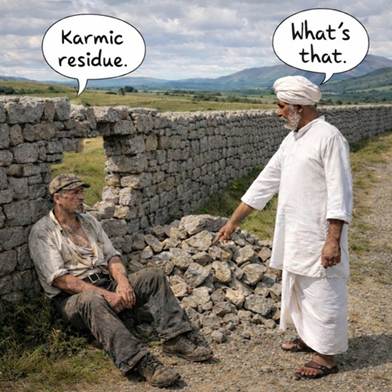
a heap of stones beside it. That is the entire
metaphysics. Everything
else is commentary. The man
built the wall. This is
not symbolism. Enter metaphysics. A
well-dressed Brahmin arrives. Clean clothes. Clean hands. Clean concepts. He
looks at the heap and asks a theological question disguised as curiosity: “What’s
that?” He is not
asking about stone. Because a
heap without a story is just evidence. So the
man gives him the smallest possible story that still fits reality: “Karmic residue.” That’s
not Eastern wisdom. Residue
is what remains when the job isn’t finished. Not
because of sin. Because
the stones didn’t fit. That’s
it. How the Vedic Ṛta Became a
Fairy Tale Ṛta originally
meant one thing: Stuff
works. Fire
burns. Procedure. No
priest. Then
someone noticed something embarrassing: Procedures
leave leftovers. Errors. So
instead of calling it what it was — unfinished work — it was upgraded. Leftovers
became
karma (actually karmic residue). Same
stones. Karma Is Not
Moral. It’s Accounting. Every
unfinished job leaves a pile. Every
incomplete solution leaves constraint. That
constraint doesn’t care about your beliefs. It only
cares whether the wall stands. Karma is not
punishment. Karma is
backlog. Moksha: The
Great Distraction Moksha is sold
as liberation. From
what? From
unfinished work. But instead
of finishing the wall, the Vedantic system invented a better trick: Declare
the wall unreal. Perfect
scam. When you
can’t finish the job, invent transcendence. When you
can’t place the stone, deny the wall. The Brutal Truth The heap
is not metaphysical. It is
procedural memory. It is
reality remembering what you didn’t finish. Not in
heaven. On the
ground. The only
mystery is why anyone needed a religion to explain a pile of rocks. Final Diagnosis Karma is not
destiny. Karma is the
mess you didn’t clean up. Moksha is not
enlightenment. Moksha (freedom) is when
there is no heap left. No
residue. Just a
finished wall. Therefore: Karma is not
what you did. Karma is what
you left undone. And no
amount of philosophy will place the stone for you. From the Rta of Veda to karmic residue and moksha |