|
The Village and the Truth-Bearer By the druid Finn
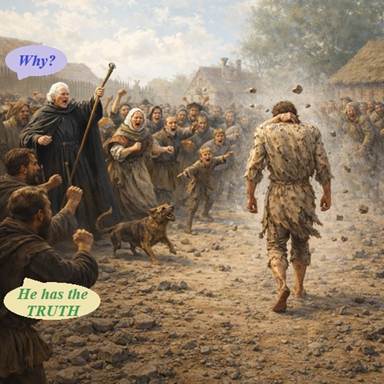
The image is not a moral scene but a procedural
diagram of one of the oldest survival algorithms in human history. It depicts
a local system (the village) executing a boundary-maintenance routine
against a destabilising perturbation. The outcast man is not expelled because he is evil,
wrong, or diseased in a moral sense. He is expelled because he carries truth
understood procedurally: an explicit manifestation of the invariant
constraints that generate the system itself. Such truth is not
propositional but structural. It exposes the rules by which the system
exists. The village, as an emergent whole, depends on partiality,
narrative buffers, and managed ignorance to remain an identifiable
reality. If the universal structure becomes fully explicit within the local
run, the run risks dissolving into structure—losing perspective, role, and
identity. To prevent this, the system must defend itself. The two speech bubbles encode the entire logic. “Why?”
marks an internal rupture: the system senses necessity without explanation. “He
has the TRUTH” is not praise but classification. It converts an
unassimilable signal into a removable container. The problem is no longer
content, but carrier. The authority figure does not invent the act; he
stabilises it. Children and the dog signal that this is not ideology but species-level
patterning. Expulsion is inheritance, not deliberation. This structure recurs everywhere: scapegoats, prophets,
Christ on the cross (“I am the truth”), whistleblowers, heretics, problematic
children, banned users. The costumes change; the algorithm does not. Core law: Truth is not crucified because it is false, but because
it is complete. A
procedural analysis of expulsion as an invariant survival algorithm |