|
The druid said: “The End Adjusts the Means” A Procedural Account of
Survival, Perfection, and the Human Predicament By the druid Finn
I. The natural grammar: continuance before intention Every
emergent—particle, molecule, organism, culture, mind—is a continuance
operation. It exists only insofar as it continues to function under
constraint in a field of unpredictable inputs. There is
no foresight in nature. There is
only: ·
random data ·
constrained (i.e.
ruled) response ·
persistence or collapse What
continues is not “right.” In such a
universe, means cannot be fixed in advance, because the space in which
they operate is not fixed. Any system that locks its methods independently
of outcome is selecting for extinction. Thus the first inversion: The
end—continuance—retroactively
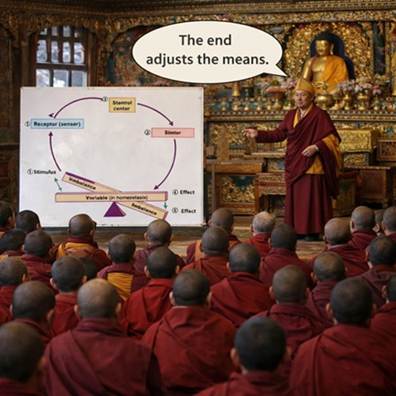
selects the means. II. Feedback replaces foresight Natural
systems do not aim; they correct. The governing
logic is feedback: 1. An action
occurs. 2. The
system survives or degrades. 3. Internal
parameters shift. 4. The next
action differs. The “end”
is not a target but a trace: the fact that the system still stands.
That trace reshapes the system’s future behaviour. This is why ends are (‘tomorrow is’) never
known in advance. They are discovered only as temporary non-failure. Hence: ·
Ends are diagnosed, not declared. ·
(Adjusted) Means are selected , not
justified. ·
Purpose is emergent, not imposed. III. Why there can be no universal end Because
every emergent ·
operates in a different constraint set ·
collides with different histories ·
receives different random inputs …it must
converge on a formally different end. Even if
two systems appear similar, the slightest divergence in context produces
divergent actual survival solutions. There is no shared telos. There is only local
adequacy. Any
doctrine that insists otherwise is already dead—merely not yet buried. IV. “God in its space”: local absoluteness To say
each emergent is “God in its space” (i.e.
an iteration of the Universal Emergents Generation
Rules Set) is not theology. It is a procedural statement: ·
there is no higher local controller ·
no external repair service ·
no appeal beyond internal coherence Each
system must complete itself (and
thus the whole) or fail. Authority is not above; it is immanent. “God”
here means: that than
which there is no higher operational authority in a given
domain. Not
omnipotence—final responsibility. V. Enter the human predicament Humans (i.e. mammals, one of 7 million species) inherit the same grammar as all emergents,
but with one destabilising addition: self-reflection. Humans
are: ·
mammals driven by biological imperatives ·
competitors among n others in finite space ·
aware that ends are contingent, invented,
revisable This
awareness produces a surplus: ·
too many possible actions ·
too many comparisons ·
too much undecided capacity In a
random competitive world, indeterminacy is lethal. A system that cannot decide
cannot act. A system
that cannot act cannot persist. Thus the human must manufacture
(artificial = AI) closure. VI. The first end: the mammalian invariant The first
end is inherited, blind, and non-negotiable: DNA transmission
and species continuation This end: ·
precedes culture ·
bypasses reflection ·
rewards compliance chemically and emotionally When
fulfilled, it produces a sense of: ·
meaning ·
rightness ·
truth ·
orgasm is completion signal This is genuine—but
it is layer-specific. It completes the mammal, not the reflective
system. The human remains local survival operationally unfinished. VII. The second end: the invented absolute To
survive as a human in the everyday context, something else is
required. The human
must invent a local, contingent end—a goal that: ·
is singular ·
is finite ·
defines success (= survival) This is
not delusion. It is engineering upgrade under uncertainty. The
goal/end may be: ·
a craft ·
a vocation ·
a destination (and any 1 will do) ·
a sport ·
a body of work ·
a cause ·
a garden ·
a child ·
a structure ·
a discipline ·
a book ·
hence any one of n goals for any one of n
emergent-as-humans. Its
content is (fundamentally) irrelevant.
Its closure properties are not. Once
adopted, the goal becomes absolute within its domain. As the druid
said: “Life is a game to played for real” The human system can now align
perfectly. In
simpler, druidic terms: “If you don’t know where you’re going, how can you get
there? And getting there is goal of goals” VIII. Why perfection suddenly becomes possible With a
locally invented end: ·
constraints become explicit ·
feedback becomes legible ·
oscillation stops ·
energy coheres For the
first time, perfection is achievable, not metaphysically, but
procedurally. This
state is experienced as: ·
clarity ·
peace ·
truth ·
enlightenment ·
release ·
“being in alignment” Not because
the goal is universally true, but because the system is complete relative
to its self-imposed constraints. IX. Two ends, one phenomenology Here lies
the trap—and the insight. Both
ends: 1. Mammalian
reproduction 2. Perfected
local function (that supports mammalian reproduction) produce
the same internal signal: (Ecstatic) Being in truth This is
why humans confuse sex, salvation, work, art, sacrifice, and transcendence.
The nervous system does not label origins; it reports closure, i.e. perfect alignment with
its originating procedure. Different
layers. X. Why the end adjusts the means—finally stated Because: ·
environments are unpredictable ·
ends are discovered only as survival traces ·
humans require closure to function ·
closure requires a locally absolute goal …the
means must remain fluid. Fixed
methods kill adaptive systems. Thus the druid’s minim is not
advice, but law: “The end adjusts the means.” Not
morally. Procedurally. XI. Final compression There is
no universal end. There is
only: ·
continuance under constraint ·
local closure under uncertainty ·
temporary perfection through alignment What
survives feels true, true
being self-signalled with the varieties of joy And that
survival, adjusts
its means. The placeholder
is empty – the user supplies the meaning The failure
modes of vacuous placeholders |