|
The Four-State Grammar of
Emergence and Moksha
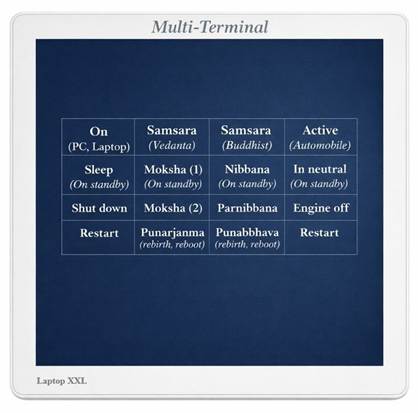
The image identifies a fundamental invariant structure
shared by all emergent systems capable of persistence and interaction: a
four-state grammar consisting of ON (active), SLEEP/STANDBY, SHUT DOWN,
and RESTART. This grammar appears in computers, automobiles,
and—crucially—in the spiritual architectures of Vedanta and Buddhism, not as
metaphor but as operational necessity. Any system that functions across time
must be able to run, pause, terminate, and potentially re-instantiate. ON / Samsara corresponds to active
transactional identity. Here, the system engages with inputs and outputs,
enacts identity, and necessarily accumulates residue (karma), understood
non-morally as write-operations into state. Action produces memory; memory
constrains future action. Samsara is therefore not a moral failure but the
thermodynamics of identity. SLEEP / STANDBY (Moksha-1 / Nibbāna-in-life)
represents powered quiescence. The system remains alive, but transactional
loops are suspended. Nirodha functions as a throttle: inhibition of
automatic writes, cravings, and reactive parsing. Phenomenologically this
appears as “consciousness without content” or “being without identity,”
experienced as ubiquity because the system has ceased performing the
boundary-drawing work that localises self and world. SHUT DOWN (Moksha-2 / Parinibbāna) is not
deeper standby but termination of the running instance, i.e. death. The
process ends; no further transactions occur. This corresponds to final
release. RESTART (Rebirth) is structural: once systems
can shut down, re-instantiation becomes a natural problem. Traditions differ
on what carries over, but rebirth reflects the persistence of incomplete
procedure. Historically, Vedic religion sought liberation by
perfecting ON (optimising samsara). Vedanta and the Nāstika
systems inverted this strategy, recognising that perfect execution
perpetuates execution. Liberation, Moksha, therefore
shifts from better performance (i.e. win) to no performance (i.e.
quit the game). The core conclusion: Freedom, Moksha, in
ancient Vedanta and Buddhism, is not achieved by running the game perfectly,
but by suspending or terminating it. The useful Lie vs.
the useless Truth Adi Shankara’s “Family Business” |